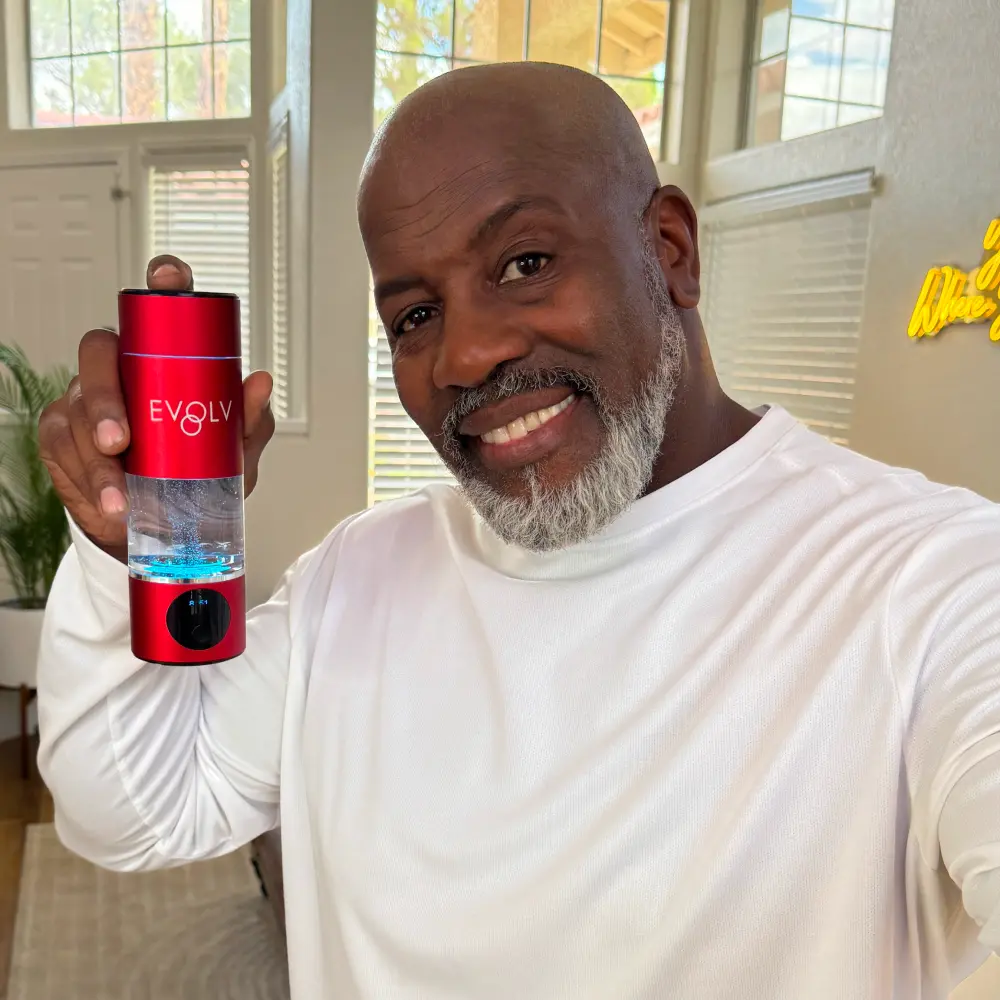
Evolv vs Cheap
The Bottle That Lies To You.
The cheap silver-cap bottles bubble away on your counter, glass after glass, looking exactly like they're working. They're not. And the cruelest part is you'd never know — until you've wasted months and quietly decided hydrogen water "just doesn't do anything for you."
★★★★☆ 4.47 / 5 · 390 verified reviews

You Thought You Were Getting Hydrogen. You Got A Light Show.
Molecular hydrogen is invisible. You can't taste it. You can't see it. So the cheap bottle can bubble beautifully and deliver almost nothing — and there's no way for you to catch it. That's not a bug. That's the entire business model.
Nearly four times the hydrogen — and the only one of the two a lab ever actually put a number on.
How The Cheap Bottle Robs You Without You Noticing
They're genuinely good marketers — we'll give them that. The bottle even looks identical. But look at the eight things the ad quietly leaves out, and you'll see exactly how the con works.
You'd Never Know. That's The Worst Part.
That's the outcome the cheap brands are quietly counting on. Not that you'll catch them — that you'll blame yourself and the science instead of the bottle. They keep your money. You lose something worth more: your belief that any of this could've helped you.
It works because there's nothing to catch. At 1.5 PPM the water still bubbles. It still looks like it's doing something. You have no way to know your glass was expensive tap water with a light show — until the months are already gone.

It Wasn't $70. It Was The Result.
Forget the price for a second. The real cost of the cheap bottle isn't the money — it's the relief you never got.
The mornings your joints could've felt looser. The workouts you could've recovered from faster. The afternoon fog that could've lifted. Every one of those was on the table — and a bottle producing 1.5 PPM quietly took them off it, one day at a time, while you kept the faith and drank up.
That's the trade the imitators never show you. You didn't just lose $70. You lost the months you'll never run back — and the version of you that could've felt better through every one of them.

An $8 Generator Can't Fake This.
The reason the cheap glass is nearly empty of hydrogen is simple: the generator in the base is built to a rock-bottom price. That kind of unit physically can't produce a serious concentration — no matter how impressive the bubbles look.
EVOLV runs a dual-chamber Japanese SPE/PEM generator with platinum-titanium plates. That's the hardware that turns bubbles into 5.42 PPM of real molecular hydrogen — and it's the reason the number survives a lab test instead of only surviving an ad.

SGS Says It's Clean. Theirs Won't Say.
Here's the part that should genuinely unsettle you. Electrolysis done cheaply doesn't just fail to add hydrogen — done wrong, it can leach byproducts into the water you're drinking three times a day.
EVOLV publishes a full SGS water-quality report: PFAS-free, heavy-metal free, chlorine-free — a document you can open and read. The cheap bottles hand you a badge and a wall of review screenshots. No independent water test. On something you put in your body daily, that silence is the answer.

"Loosen The Cap." Read That Again.
Buried in the cheap bottles' own instructions is a line that gives the whole game away: run it too long and you're told to "loosen the cap to relieve pressure." That's a build cutting corners on the one part that has to safely hold gas.
EVOLV's chamber is rated for 150 PSI and molded from BPA-free German food-grade polycarbonate. It's engineered to make high-concentration hydrogen every single day — no babysitting, no cap-cracking, no compromise.

Even The Bubbles Fade On You.
Ask the cheap brands how long the generator holds its output and you get silence — the lifespan simply isn't listed. Cheap plates degrade. A bottle that looked like it was working on day one can be producing almost nothing by month six, and you'd have no way to know. The theft just quietly deepens.

Certified Eight Ways. Not One Badge.
A single certification badge is easy to slap on a page next to some five-star screenshots. That's marketing. Real proof is a stack a stranger can independently verify.
EVOLV carries 8 certifications — H2Analytics gas-chromatography, H2Hubb H2Blue reagent, SGS water quality, PFAS-free, platinum electrolysis and food-grade material verification. Every claim on this page is a document, not an adjective.

Cheap Isn't Cheap. When It Does Nothing.
Here's the trap in one sentence: a $70 bottle at 1.5 PPM was never "the affordable choice." It's full price for water that barely carries hydrogen. The most expensive bottle in the world is the one that quietly does nothing — and takes your belief in the result with it.
EVOLV is a $300-class device priced at $150, lab-verified at 5.42 PPM, HSA/FSA eligible, backed by a 45-day money-back guarantee. Test it. Measure it if you want. Keep it — or send it back. That's the confidence only a real device can put in writing.

Every Number Here Is Measured
Not headlined in an ad. Tested, documented, and independently verified.
Don't Give Them Another Month.
The imitators nailed the shape and the marketing. They just couldn't put the hydrogen in the water — and they're betting you'll never find out. EVOLV puts it in writing: 5.42 PPM, from a lab. Stop wondering if it's working. Know.
The EVOLV Hydrogen Bottle
- 5.42 PPM · gas-chromatography verifiedIncluded
- Dual-chamber platinum SPE/PEM generatorIncluded
- SGS water report · PFAS & heavy-metal freeCertified
- Free 13-month warrantyFree
- 45-day money-back guaranteeFree
- HSA / FSA eligible checkoutYes
Often imitated. Never duplicated. Now you know why.
*These statements have not been evaluated by the Food and Drug Administration. This product is not intended to diagnose, treat, cure, or prevent any disease. Comparative PPM figures reference concentrations published by respective manufacturers on their own product pages and independent third-party lab testing; competing products are referenced as a category and individual products may vary. EVOLV's 5.42 PPM figure reflects gas-chromatography testing under Mode 2 (10-minute cycle); actual output varies by cycle length, water source, and use.